
 Magnetism & Magnetic Trends
This page will consider several concepts related to magnetism from the point of view of sub-quantum mechanics, factoring in its perspective on electron interactions in magnetic field space and spin space. The 3rd-shell transition metals will be compared, and the concept of pd-hybridization will be employed, in an attempt to account for the periodic trend in magnetic susceptibility (χm) strength.
Below, we will briefly address the nature and mechanisms behind:
- MAGNETISM: What is it, really?
- PARAMAGNETISM: What causes temporary magnetic attraction?
- DIAMAGNETISM: Temporary magnetic repulsion and its periodic strength trend.
- FERROMAGNETISM: What causes permanent magnetic attraction?
- FERROMAGNETIC STRENGTH: What accounts for its periodic trend?
- CURIE TEMPERATURE TREND: Why do they lose magnetism in that order?
- WHY ONLY THESE THREE?: Why are only Fe, Co, & Ni ferromagnetic?
- ANTIFERROMAGNETISM: What causes equal and opposite alignment?
- OTHER FORMS OF MAGNETISM
1. What Is Magnetism?
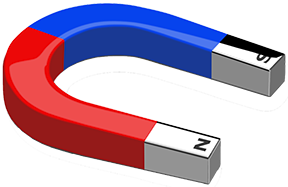
Magnetism can be understood as a force of attraction or repulsion resulting from the flow of electric current or the spin of a charged particle.
According to both the Williamson-van der Mark and Robinson models, subatomic particles are made of self-confined knots of electromagnetic radiation, and as such, they cause electric and magnetic fields to be introduced into the spacetime around them.
In the toroidal, double-loop rotation of the electron [ref] in momentum space, for example, chirality is immediately a characteristic of the system, and this naturally divides ‘spin reactions’ (magnetism) into two complementary forms that we call north and south. They are simply the two relative chiral orientations of the rotating electromagnetic flow. By way of example, Earth’s rotation will appear right-handed (counter-clockwise) when viewed from above the north pole, but left-handed (clockwise) when viewed from above the south pole.
In an electron, the (instantaneous) north magnetic pole lies along the axis running through the center of the toroidal momentum topology, in the direction of the thumb in a left-handed chiral rotation. South lies in the opposite direction along the same axis. In an isolated electron, the magnetic field averages to zero (due to the electron’s spherically-symmetrical spin). The magnetic moment of the electron emerges only in the presence of an external field, which breaks the internal spherical symmetry of the isolated electron. (According to this model, a positron has the same topology, but with a right-handed chirality (as shown below, right), which is what gives it the opposite charge.)

(The above images are of photon topologies in momentum space, and as such, they should not be taken as representing literal toroidal structures in 3D space. In normal space, free electrons are spherically symmetrical. See Understanding electrons for more.)
When the (magnetic field) influence of a particle’s spin is extended into the spacetime around it, other magnetic fields respond to it when they encounter it. The magnetic fields of other nearby electrons will therefore interact with this electron’s field in such a way that north repels north but attracts south. This ultimately derives from the fact that angular momenta are either working together and lowering energy (attraction), or resisting each other and increasing energy (repulsion). [Ref]
An unpaired electron therefore has a magnetic field as a result of its spin and its internal toroidal photon topology.
When many (unpaired) electrons exist in concert, for instance within a solid crystal, various different forms of magnetism can result, depending upon the geometry of and the interactions between these electrons. Some of these forms of magnetism will be discussed below.
The most well-known form is ferromagnetism (see below), in which the unpaired electrons throughout a metal crystal align their magnetic spins, and are able to hold this crystal-wide alignment. The crystal as a whole then manifests a macro-magnetic field, becoming a permanent ‘ferromagnet.’ The most important example of this occurs in iron (Fe).
When electrons (with opposite spins) pair up, on the other hand, they superimpose in a way that finds them perfectly anti-parallel. This allows their magnetic fields to cancel against one another, which lowers energy significantly, making this a highly favorable state. One example of this is the electron shell of a helium (He) atom. Due to its internal magnetic field cancellation, this di-electron pair is no longer attracted towards other magnetic fields, but rather, repels them. This is called diamagnetism (see below), and it happens in order to maintain the pair’s lowest energy state of perfect field cancellation.
2. Paramagnetism
In the presence of an external magnetic field, the unpaired electrons in an atom or substance will orient their spins to align with the magnetic field. This will cause it to be drawn into and toward that field — via magnetic field cancellation — giving it a positive magnetic susceptibility (χm) value. This attractive force is called paramagnetism, and its effects only last as long as the external magnetic field is present. We might therefore presume that, the stronger the paramagnetism, the more ‘unpaired electron character’ is present. Surprisingly, this does not seem to go according the number of unpaired electrons present.
3. Diamagnetism
Diamagnetism occurs when a substance is repelled from a magnetic field because it contains di-electrons. These paired electrons are in a state of perfect field cancellation with one another. The presence of an external magnetic field will disrupt the harmonic coherence of their di-electron states, raising energy. This causes the atom to repel away from the external magnetic field in search of a lower energy state.
Diamagnetic substances have negative magnetic susceptibility (χm) values.
ANALYSIS:
Zinc (Zn): Zinc’s 3rd shell is full, with a symmetrical cubic arrangement of 8 field-repelling di-electrons, and its 4th shell has the 4s2 di-electron. Zinc has a low magnetic susceptibility value of χm=–9.15.
*
Copper (Cu): Copper’s 3rd shell is full, with a symmetrical, cubic arrangement of 8 field-repelling di-electrons, just like zinc, however copper has a less diamagnetic value of χm=–5.46. It is conjectured that, because it also has one unpaired 4s1 electron, the bulk material may inherit less electron pair character, or equivalently, more unpaired electron character.
4. Ferromagnetism
Ferromagnetism occurs when the electrons in a substance are able to retain their internal crystalline magnetic field alignment after the external field that aligned them is removed. The solid can therefore act as a permanent magnet. This property therefore depends directly upon how well the unpaired electrons on adjacent atoms can link their spins and magnetic fields, thereby holding one another in alignment.
It is proposed in the Quicycle model that there are two criteria that facilitate a metal crystal achieving ferromagnetic spin bonding, and thus, a crystal-wide ferromagnetic spin resonance. Note that these are hypotheses, not established necessary-and-sufficient criteria:
- CRYSTAL GEOMETRY: For optimal spin bonding, unpaired core electrons should have an electron domain geometry that matches the crystal unit cell geometry. We propose that the 8-directional symmetries that arise in Fe, Co, and Ni as a result of pd-hybridization may provide these.
- SUFFICIENT ORBITAL EXTENSION: It is proposed that unpaired d-orbital valence electrons require radial extension in order to interact (via spin bonding) with similarly extended electrons on adjacent atomic cores in a crystal. We propose that this is achieved as a result of sufficient di-electron (electron pair) repulsion within the atomic shell, along with added repulsion from the di-electrons in the 2nd shell that lie directly beneath the unpaired electron orbitals. This criterion is therefore intimately related to the electron geometry (from criterion #1 above), as well as to the number of same-shell di-electrons constricting the unpaired electron orbitals.
NOTE: This geometry matching and radial extension are Quicycle hypotheses, not established necessary-and-sufficient criteria for ferromagnetism. Ferromagnetism is a collective band-and-exchange phenomenon. The Quicycle model attempts to account for why this band-and-exchange state is achieved in only such specific cases. This hypothesis has yet to quantitatively reproduce magnetic moments, exchange interactions, temperature dependence, and phase behavior.
In this model it is suggested that only with both of these criteria fulfilled (see below), will a transition metal be ferromagnetic. If only one is present, or if constriction and extension are not sufficient, the element will be paramagnetic.
5. Ferromagnetic Strength Trend
The following diagram shows the relative ferromagnetic strengths of the 3 ferromagnetic transition metals, along with the orbital geometries and orbital extension proposed for their unpaired electron orbitals.

ANALYSIS:
Iron (Fe):
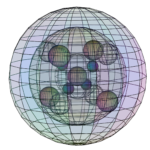
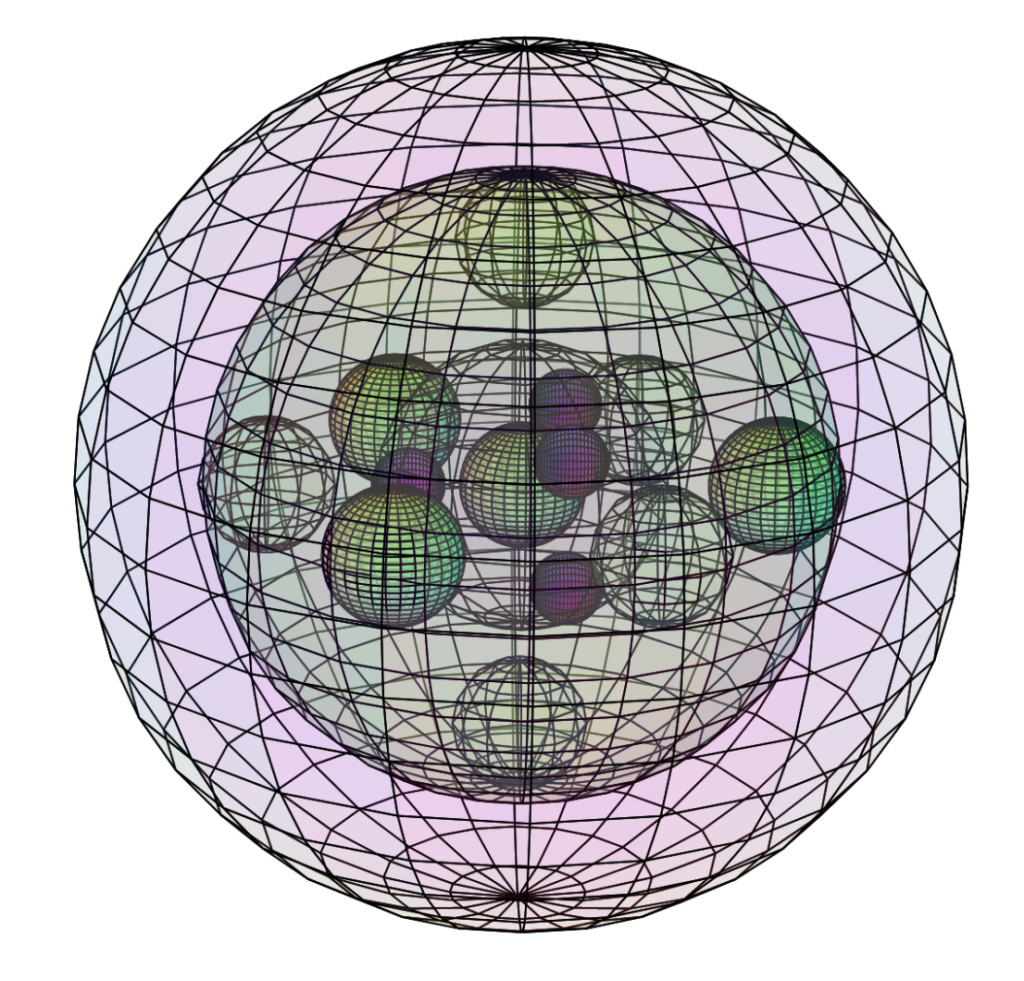
It is proposed that, in its ferromagnetic form, iron’s 3rd shell contains 4 di-electron orbitals and 4 unpaired electron orbitals in p3d5-hybridization, stabilized by the ‘fundamental’ of the 3s2 di-electron.
CRYSTAL GEOMETRY: Body-centered cubic (BCC) — when ferromagnetic
Iron has 4 unpaired electron orbitals in tetrahedral symmetry around the atomic cores. This is compatible with the (double tetrahedral) structure of a BCC crystal.
SUFFICIENT ORBITAL EXTENSION: by 8 di-electrons
Unpaired electron orbitals are constricted by 4 same-shell di-electrons, as well as by 4 di-electrons in the 2nd shell directly beneath them.
According to this model, iron has four instances of ferromagnetic spin bonding per atom. Not only is the geometry perfectly symmetrical, crystal-wide, but the unpaired electron orbital constriction and extension are also significant, caused by 8 di-electrons. It therefore makes sense that, compared to cobalt and nickel, iron would be significantly more ferromagnetic, which it is.
For more detail, see Iron (Fe)
*
Cobalt (Co):
 It is proposed that, in its ferromagnetic form, cobalt’s 3rd shell contains 5 di-electron orbitals and 3 unpaired electron orbitals in p3d5-hybridization, stabilized by the ‘fundamental’ of the 3s2 di-electron.
CRYSTAL GEOMETRY: Hexagonal close-packing (HCP) and face-centered cubic (FCC) — when ferromagnetic
Cobalt has 3 unpaired electron orbitals in trigonal planar symmetry around the atomic cores. This is compatible with the structures of both HCP and FCC crystals. In its ferromagnetic state, cobalt assumes an HCP crystal structure below 450ºC, and an FCC structure above it.
SUFFICIENT ORBITAL EXTENSION: by 7 di-electrons
Unpaired electron orbitals are constricted by 5 same-shell di-electrons, as well as by 2 of the 4 di-electrons in the 2nd shell beneath.
According to this model, cobalt has three instances of ferromagnetic spin bonding per atom. Not only is the atomic geometry within the crystal primarily symmetrical in two dimensions — trigonal planar within the hexagonal layers — but the unpaired electron orbital constriction and extension are only caused by 7 di-electrons. It therefore makes sense that, compared to iron, cobalt would be significantly less ferromagnetic, which it is.
For more detail, see Cobalt (Co)
*
Nickel (Ni):
It is proposed that, in its ferromagnetic form, nickel’s 3rd shell contains 6 di-electron orbitals and 2 unpaired electron orbitals in p3d5-hybridization, stabilized by the ‘fundamental’ of the 3s2 di-electron.
CRYSTAL GEOMETRY: Face-centered cubic (FCC) — when ferromagnetic
Nickel has 2 unpaired electron orbitals in linear symmetry around the atomic cores. This is compatible with the structure of a FCC crystal (given the crystal-wide linearity of the FCC unit cell diagonal).
SUFFICIENT ORBITAL EXTENSION: by 7 di-electrons
Unpaired electron orbitals are constricted by 6 same-shell di-electrons, as well as by 1 of the 4 di-electrons in the 2nd shell beneath.
According to this model, nickel has only two instances of ferromagnetic spin bonding per atom. Even though the atomic geometry within the crystal is face-centered cubic, the spin bonding connections are linear — in a sense, symmetrical in only one dimension. The unpaired electron orbital constriction and extension are also only caused by 7 di-electrons. It therefore makes sense that, compared to iron and cobalt, nickel would be less ferromagnetic than both, which it is.
For more detail, see Nickel (Ni)
6. Curie Temperature Trend
 Iron is by far the most strongly ferromagnetic of the three metals, yet cobalt has a higher Curie Temperature. This means that, even though iron is more strongly magnetic, cobalt (Co) can hang on to its magnetization to a much higher temperature. That must mean its ferromagnetic spin resonance is stronger than iron’s. How might we explain this?
According to the present proposed model, we might speculate that the reason for this is as follows. Cobalt contains three instances of ferromagnetic spin bonding (FSB) per atom, and the resonance is essentially two-dimensional, in the hexagonal crystal layers. Iron contains four instances of FSB per atom, and the resonance is three-dimensional and perfectly tetrahedral throughout the lattice. This causes iron to have a far more significant ferromagnetic spin resonance throughout its crystal, making it more strongly ferromagnetic than cobalt.
However, each of cobalt’s three instance of FSB involves 3 electrons holding each other in spin resonance. Each of iron’s four instances involve only 2-electron resonances. As such, cobalt’s spin bonding resonances are stronger and will therefore be able to withstand higher temperatures without thermalization disrupting them out of resonance. It is therefore proposed that this is what gives cobalt a higher Curie Temperature than iron, in spite of its weaker ferromagnetic strength.
7. Why Only Fe, Co & Ni?
Of the 3d transition metals, only iron, cobalt and nickel exhibit ferromagnetism. The others are all paramagnetic, except for copper and zinc, which are diamagnetic, and chromium, which is antiferromagnetic (at room temperature).
It is proposed that the transition metals of the 3d block that precede iron — scandium through manganese — are paramagnetic and not ferromagnetic because they do not have sufficient orbital constriction and extension of their unpaired electron orbitals. This would appear to be because the unpaired electron orbitals are sharing the shell with only 3 di-electrons.
It is unclear as to why criterion #2 appears to have a threshold of 4 di-electrons (in the case of the 3d transition metals), though we might speculate that it is because then at least half of the hybrid shell contains di-electron density, along with a consequently large amount of orbital constriction. (This would only be true from iron onward.)
WHY IS MANGANESE PARAMAGNETIC?
Why is manganese (Mn) paramagnetic (see above) and not ferromagnetic? It has the same electron geometry as cobalt, which is ferromagnetic, and manganese even has two more unpaired electrons than cobalt.
According to the present model, criterion #2 of ferromagnetism is not fulfilled. It is proposed that, with only 3 di-electrons constricting manganese’s 3rd shell unpaired electrons, its unpaired electron orbitals do not experience sufficient orbital extension to activate ferromagnetic spin bonding.
(See below regarding the antiferromagnetism of chromium (Cr).
8. Antiferromagnetism
Antiferromagnetism is a state in which the unpaired electron spins on adjacent atoms in the metallic crystal are anti-parallel to one another. This creates a net spin-zero state for the crystal as a whole, and it will therefore not exert an external magnetic force.

Chromium (Cr):
Elemental chromium is an itinerant, incommensurate spin-density-wave antiferromagnet below its Néel temperature of about 311 K (38°C) and is paramagnetic above it.
9. Other Forms Of Magnetism
There are also other forms of magnetism, for example ferrimagnetism, altermagnetism, and an effect known as ‘spin glass‘ involving neodymium (Nd), but these will not be investigated here
References: See DeMystifySci Podcast: The Strange Behavior Of Humans And Magnets for a brief video discussion of this concept.
 J.G. Williamson, M.B. van der Mark, ‘Is The Electron A Photon With Toroidal Topology?’, Annales de la Fondation Louis de Broglie(1997) J.G. Williamson, A. Benn, M. Rudolph, ‘Quantum Spin Coherence In 4 Derived 3-Spaces’, Quicycle Journal (2022) A. Benn, J.G. Williamson, ‘pd-Hybridization And The Electron Geometry Of Fluorine, Neon And Iron’, Quicycle Journal (2024)
BACK TO PERIODIC TABLE